.png)
Why Securing a Patent in Tanzania Could Be the Smartest Business Decision You Make..
- TCI

- Apr 27
- 11 min read
If your innovation can be copied, your growth can be copied too. The companies that win are not always the first to build. They are often the first to protect.
Imagine building the future, then watching someone else cash in first..
Imagine spending months, or even years, developing an idea that could genuinely change your business. Maybe it is a software platform. Maybe it is a manufacturing method. Maybe it is a new product design, a workflow, a technical process, or a smart way of solving a market problem that others have ignored. You invest time, talent, money, and energy into getting it right. You test it. You improve it. You introduce it to the market. People begin to notice.
Then something happens that many innovators never prepare for properly.
Somebody copies it.
They may not copy every detail. They may change the branding. They may package it differently. They may move into a neighboring region first, or present a version to clients who do not know you were the original innovator. But the result can be painfully familiar. The market attention you created starts benefiting somebody else. Your pricing power weakens. Your uniqueness starts fading. And the advantage you worked so hard to build begins to slip.
This is exactly why patents matter.
Too many businesses treat patent protection like an optional legal extra, something to think about later when the company is bigger, when revenues improve, or when investors ask. But by the time many founders start thinking seriously about protection, the market has already seen too much. The risk has already increased. Competitors are already watching.
In a growth market like Tanzania, that is a dangerous delay. Innovation is expanding. Competition is maturing. Investors are paying closer attention to intellectual property. Regional expansion is becoming more realistic for ambitious businesses. In that environment, an unprotected innovation is not just vulnerable. It can become an opportunity for somebody else.
That is why securing a patent can be one of the smartest business decisions a company makes. It is not only about filing paperwork. It is about controlling value before the market starts redistributing it.

Innovation without protection is exposure
A strong idea can open doors. But a protected idea can keep those doors open long enough for your business to grow through them.
This is where many entrepreneurs, companies, and even institutions get it wrong. They focus heavily on product development, software build cycles, sales channels, launch timing, funding conversations, and marketing execution. All of that matters. But there is one question that often stays in the background until it becomes urgent: what stops someone else from doing the same thing tomorrow?
If the answer is unclear, the business has a vulnerability.
Patent protection matters because it turns an innovation from a hopeful market advantage into a more defensible commercial asset. It helps define ownership. It strengthens exclusivity. It gives a company a firmer position when dealing with partners, investors, distributors, and competitors. It tells the market that this invention is not simply a good idea floating in the open. It is something structured, claimed, and legally supported.
For local innovators in Tanzania, this can make the difference between leading a category and training the market for imitators. For international investors, it helps reduce one of the most important risks in innovation-driven ventures: the possibility that the core value can be copied too easily. For larger organizations, it supports internal innovation programs, new product launches, and strategic expansion into emerging sectors.
A patent does not magically guarantee commercial success. But it can make success easier to defend. And in competitive markets, that matters more than many people realize until it is too late.
What a patent really gives you: more than a legal document
When people hear the word patent, they often imagine a formal certificate, legal language, and a technical process handled quietly in the background. That picture is incomplete.
A patent is not only a legal document. It is a business tool.
At its best, patent protection can create market exclusivity, strengthen investor confidence, support licensing opportunities, improve negotiation power, and help a company build with more confidence during the most important growth years. It can also signal seriousness. In many commercial settings, a business with a clear intellectual property strategy simply appears more mature, more structured, and more defensible.
This matters because value in business is often tied to control. If your company has developed something distinctive, the question is not only whether customers like it. The question is whether your business can control the commercial upside of that distinctiveness for long enough to benefit meaningfully from it.
That is the role a patent can play.
It can help protect a new product from direct imitation. It can help protect a technical method from being used by competitors without authorization. It can strengthen a software-related innovation where the underlying technical solution deserves proper strategic assessment. It can help a company negotiate licenses instead of watching third parties use the invention freely. And it can support expansion by giving the business stronger ownership credentials as it enters new markets.
Seen this way, a patent is not just about stopping others. It is also about empowering the original innovator to move faster, negotiate better, and build more boldly.

Why the first 7 to 10 years often decide who wins
This is one of the most important points for business owners and investors to understand clearly.
When people talk about securing the market for 7 to 10 years, they are usually speaking about the key commercial window, not the legal expiration date of a patent. In practice, the early years after launch are often the period when a company has the greatest opportunity to shape the market, build distribution, recover development costs, establish authority, and turn innovation into meaningful revenue.
Those first years matter because that is when the category is still being formed. Customers are learning. Competitors are watching. Investors are evaluating whether the business can hold its advantage. Pricing is still being tested. Partnerships are still being negotiated. The company that controls this period well often becomes the market reference point.
Patent protection supports that control.
Without a strong protection strategy, a company may spend the early years creating awareness and proving demand, only for copycats to step in once the hard part is done. That can weaken margins, dilute market share, and reduce the return on innovation just when the original business should be benefiting most.
With a stronger IP position, the company can approach those years differently. It can raise capital with a stronger story. It can discuss licensing from a firmer position. It can build partnerships with less fear of immediate imitation. It can invest in visibility knowing that the core innovation is not simply exposed to anyone willing to replicate it.
That is why serious businesses do not treat patent work as a side issue. They treat it as part of their market entry strategy.

Why Tanzania is becoming a more important patent market
Tanzania is attracting attention for good reason. It is a growing economy with active sectors in technology, manufacturing, agribusiness, logistics, energy, digital services, and industrial innovation. Local entrepreneurship is becoming more sophisticated. International players are exploring partnerships and market entry. Organizations are increasingly focused on systems, efficiency, and innovation-led growth.
That creates opportunity. It also creates risk.
In a market with rising innovation activity, useful ideas do not stay invisible for long. A strong concept can move quickly through sectors, networks, pilot programs, supply chains, and procurement channels. If the underlying innovation is not protected properly, it may become easier for competitors or imitators to benefit from the momentum created by the original innovator.
For businesses launching in Tanzania, patent strategy should therefore be seen as part of commercial readiness. It is not only relevant to large multinationals. It matters to startup founders, engineering teams, industrial businesses, research-linked ventures, health and agriculture innovators, software-enabled service models, and organizations developing internal technical solutions with wider market potential.
A company that secures protection early signals professionalism and foresight. It shows that management understands that innovation is not merely something to build. It is something to protect, position, and monetize.
For investors, that matters. For strategic partners, that matters. And increasingly, for the Tanzanian market itself, that matters too.
Lead generation takeaway: a patent conversation should start before the market fully understands the innovation, not after competitors do. |
Can software, products, methods, and systems all be protected?
This is where the conversation becomes especially interesting and commercially important.
Many businesses assume patents only apply to physical inventions. Others assume software can always be patented. Both assumptions can be misleading. The real answer depends on the actual nature of the innovation, the legal framework involved, and the way the invention is structured and described.
A product may be patentable because of a specific technical feature or functional improvement. A method may deserve protection because it introduces a novel and commercially valuable technical process. A system may contain inventive elements in the way components interact to solve a practical problem. A software-driven innovation may need careful evaluation to determine whether the real value lies in a technical solution, a broader business method, copyrighted code, trade secrets, or a blend of protections.
This is why serious businesses should avoid oversimplifying the question. The right issue is not just, “Is this software?” or “Is this a product?” The better question is, “What exactly is innovative here, what is commercially central, and what form of protection gives the business the strongest advantage?”
At TCI Consultants, this is one of the reasons we take a strategic approach. We do not reduce patent work to a drafting task. We look at the business case, the invention structure, the regional growth plan, and the commercial value that needs to be defended. That helps clients avoid weak assumptions and move toward stronger protection decisions.

Why investors and serious partners care about patents
An investor rarely asks only whether an idea is exciting. The deeper question is whether the business can hold its position long enough to create real returns.
That is why patents matter so much in investment conversations.
A company with protected innovation often looks more investable because it appears more defensible. It suggests that the founding team or management understands strategic risk. It shows that the business is not relying only on speed, secrecy, or hope. It has taken steps to create a barrier around the value it is building.
This can influence more than fundraising. It can improve partnership discussions, joint venture negotiations, licensing opportunities, and distribution conversations. A patent-backed business usually has a stronger story to tell. It can explain not only why the product matters, but why the company has a credible claim to the opportunity surrounding it.
For local businesses seeking growth capital, this can improve confidence. For international investors entering Tanzania, it can reduce uncertainty. For organizations evaluating technical partners, it can strengthen trust. And for acquirers or strategic buyers, protected IP can increase the attractiveness of the business as a whole.
Put simply, investors do not only want innovation. They want protected innovation with room to scale.
Why filing only in Tanzania may not be enough for ambitious businesses
Many businesses begin in one market and assume protection in that market is enough. Sometimes it is. Often it is not.
If your company plans to distribute, license, manufacture, franchise, or expand across the region, it is worth thinking beyond one country from the beginning. That is especially true for businesses with scalable products, technical methods, software-enabled systems, manufacturing processes, and innovations that can travel quickly into adjacent markets.
At TCI Consultants, we support patent filing strategy not only in Tanzania but also with broader thinking across EAC and SADC countries. That matters because regional growth often happens faster than expected. Once a business gains traction, new jurisdictions start becoming relevant through customers, partners, competitors, procurement networks, and supply chains. If the company has not thought about protection regionally, it may discover too late that its legal position is stronger in one market than in another.
Regional strategy does not mean filing everywhere blindly. It means deciding where protection is commercially justified, where growth is likely, where competitive risk is real, and how to align filing decisions with business priorities.
This is one of the reasons patent planning works best when it is connected to business strategy rather than treated as an isolated legal step. The strongest protection plans are rarely random. They are designed around how the company actually intends to grow.
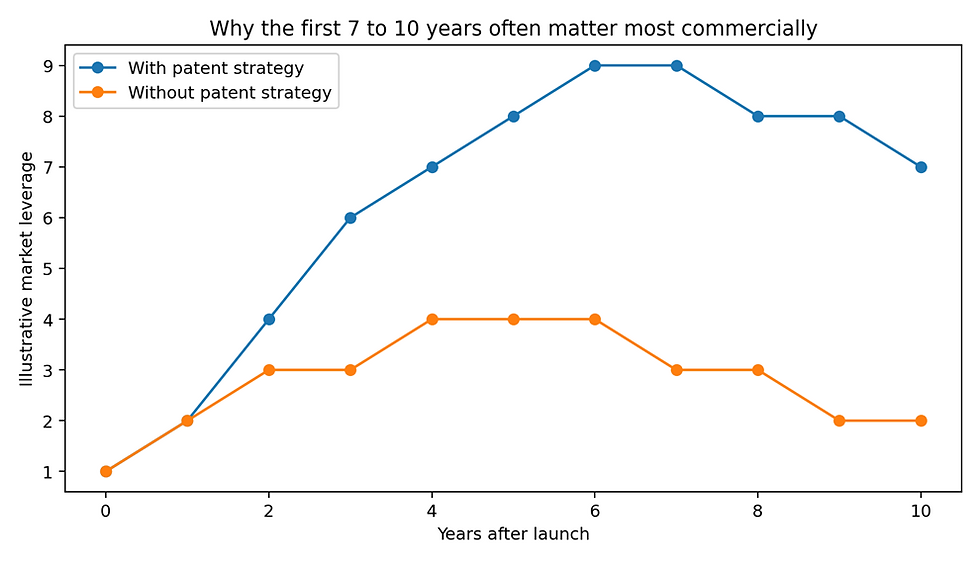
Visual 2. The first 7 to 10 years are often the most decisive commercial window, even though legal patent terms can run longer.
The biggest mistake: waiting until the market already sees your value
One of the most common and costly mistakes in innovation-led businesses is delay.
A founder wants to finish the product first. A company wants to see customer demand first. A team wants to keep moving fast and return to protection later. On the surface, this sounds practical. In reality, it can weaken the business.
The problem is that markets rarely wait politely while you get organized. Once an invention becomes visible, discussed, demonstrated, sold, or copied in informal ways, the strategic position can become more complicated. The company may still have options, but some of the strongest advantages of early, deliberate protection can begin to fade.
Acting early does not mean filing carelessly. It means assessing the invention before exposure creates unnecessary risk. It means understanding what is worth protecting, what the commercial priorities are, and what route will best support long-term value. It means treating intellectual property as part of go-to-market planning rather than a reaction to imitation.
This is especially important for businesses that want to attract investors, expand regionally, or establish strong category leadership. Early patent strategy signals seriousness. It gives management stronger control over timing, disclosure, messaging, and commercialization. And often, it is far more affordable than trying to repair a weak position after the market has already moved.
Why TCI Consultants approaches patent writing differently
Patent drafting is often treated as a purely technical exercise. At TCI Consultants, we approach it differently.
We combine technical structuring, legal positioning, and market and commercialization insight so that the patent is not just written, but strategically built around the value the business is trying to protect. That means we look at the invention in context. What exactly makes it commercially significant? Where is the real competitive edge? Which elements matter most to future revenue, licensing, regional expansion, or investor interest? How should the protection strategy support those goals?
This approach matters because a patent should do more than exist on paper. It should support the business.
For local innovators, this means turning ideas into more structured and defensible assets. For international investors and organizations, it means getting support that reflects both African market realities and broader commercial objectives. For growing companies, it means approaching patent work with the seriousness usually reserved for core business strategy.
We also recognize that businesses need more than drafting alone. They need guidance. They need clarity. They need practical thinking about filing in Tanzania, wider positioning across EAC and SADC where relevant, and the commercial logic behind each step.
That is the role we aim to play: not just writing documents, but helping clients protect value more intelligently.
Final thought: protect it before you scale it
If your innovation has real value, someone else will eventually notice. That is not pessimism. It is reality.
The market rewards useful ideas. But it also attracts imitation, adaptation, and fast followers. The real question is not whether your innovation deserves protection. The real question is whether you will act before the market starts testing your position.
For some businesses, that means protecting a product before a wider rollout. For others, it means evaluating a software-related technical solution before exposure increases. For others still, it means reviewing a manufacturing method, process flow, or system design that could become the foundation of a larger commercial opportunity.
What matters is action.
The businesses that build durable advantage are often the ones that think early about what must be defended, how it should be framed, and where protection should support future growth. In Tanzania and across African growth markets, that discipline is becoming more important every year.
At TCI Consultants, we help innovators, companies, investors, and organizations move from vulnerable ideas to protected commercial assets. If you are developing something distinctive, this is the moment to look seriously at how it should be protected.
Do not wait until the market proves you were right. Protect the value while you still control the story.
Ready to secure your innovation?
· Patent writing and drafting support
· Patentability and novelty assessment
· Patent filing strategy in Tanzania
· EAC and SADC protection planning
· Commercialization-focused IP advisory
If your organization is building a product, software-enabled technical solution, method, process, or system worth defending, TCI Consultants can help you assess, structure, and protect it with a commercially grounded approach.
Suggested search snippet


Comments